Communication · EQ · Happiness · Leadership · Self-leadership
Conversations To Foster Greater Understanding
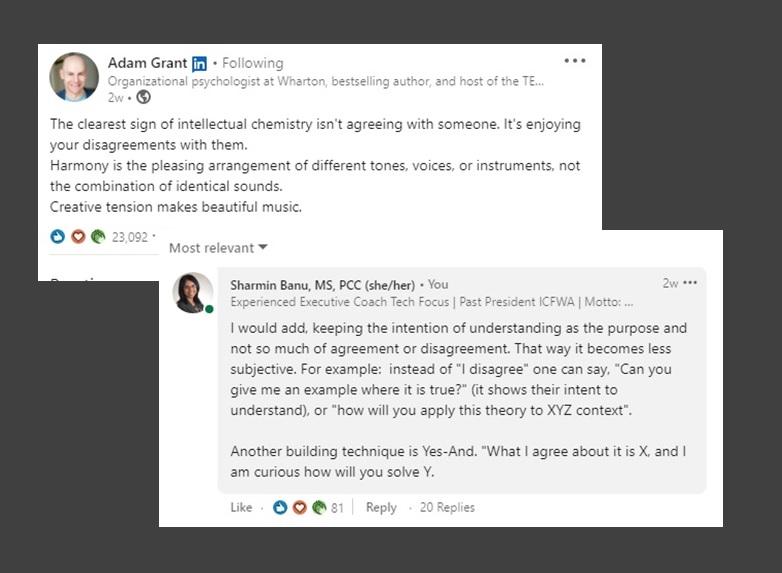
Recently this post by an organizational psychologist at Wharton, Adam Grant, went viral on LinkedIn. He said:
The clearest sign of intellectual chemistry isn’t agreeing with someone. It’s enjoying your disagreements with them. Harmony is the pleasing arrangement of different tones, voices, or instruments, not the combination of identical sounds. Creative tension makes beautiful music.
Adam Grant’s LinkedIn Post on Harmony and Disagreement
I commented there, which became most popular on that post (80+ likes and 20 comments).
I would add, keeping the intention of understanding as the purpose, and not so much of agreement or disagreement. That way, it becomes less subjective. For example: instead of “I disagree,” one can say, “Can you give me an example where it is true?” (it shows their intent to understand), or “how will you apply this theory to XYZ context.” Another building technique is Yes-And. “What I agree about it is X, and I am curious how you will solve Y.
The popularity of this post and the comment indicate a hunger for such a topic. Given the 2016 US presidential election, the Women’s March, the Black lives matter movement, the wealth divide, the climate crisis, and recently the COVID19 and the social isolation – I see why many are thinking this way. We seek greater understanding – a crucial first step to healing and unity in our families, workplaces, and communities.
What Is Getting In The Way?
Lack of trust, negative stereotyping, seeing others as less-than, fear, and ego are undoubtedly the big culprits. There is plenty of research and resources out there for such issues. In this article, I focus on the ones below that are more subtle but prevailing among well-meaning people, including myself. These tendencies appear everywhere, from living rooms to boardrooms, and nowadays, in our Zoom rooms.
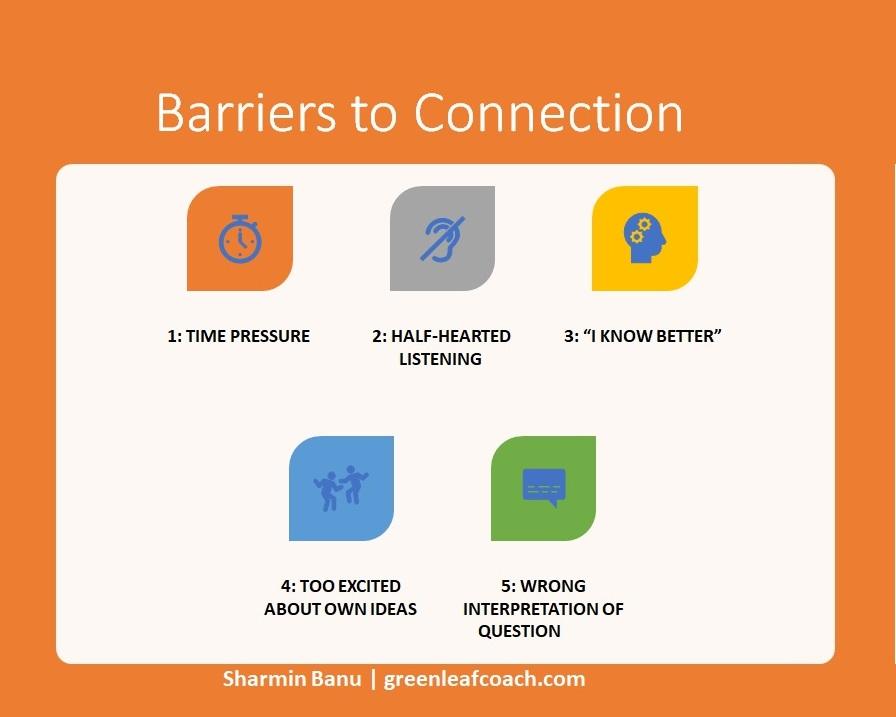
Fig: Barriers to Better Connection
Tendency 1: Time pressure – I don’t have the time or patience to understand your state of mind or intention; I give my answer as quickly as possible.
Tendency 2: Half-hearted listening – I hear the first part of your sentence; I quickly map it to something I heard, read or know already; hence I form my response before even you finish your sentence.
Tendency 3: “I know better; I save your time by correcting you” – I see that your thoughts are going in the “wrong” direction, and the sooner I correct you, the better it is for everyone.
Tendency 4: I am too excited to share my idea. – I will talk over or interrupt to get my point across.
Tendency 5: I fail to notice someone sharing their opinion in disguise of a question. – This could be a stylistic difference or a psychological safety issue. In such cases, if we are used to giving a direct opinion, we may assume it was a question to answer.
The Problems These Tendencies Create
Even when I know more than you do, If I give you the answer before you are ready to hear, you may not receive it the way I intend. No matter how wise my opinion is, it won’t have much value without someone receiving it.
Many times I have a partial understanding in my head. However, since it is how I see it, I won’t know how to expand/update it unless I take the time to see others’ viewpoints.
When I don’t listen to understand or interrupt often, I inadvertently undermine you. It hurts relationships.
When I overlook the statement behind the pseudo question, I miss the opportunity to acknowledge your opinion. You might see me as insensitive.
An example conversation of fostering greater understanding
I recently participated in a 1:1 conversation organized by Braver Angles to connect as citizens concerned for their country. According to them, “…We are now as polarized as we have been since the Civil War. The national and global challenges require us to support each other like never before.”
They matched me, an immigrant from Bangladesh, an engineer, and a coach by training living in Seattle with a white European descendant, 3-4 generations American, and a pastor from New Jersey. We took turns to share our backgrounds, our dominant group’s traits, interests, and likings in an hour-long conversation. We listened empathically, appreciated the other person, and asked follow-up questions to hone our understanding. The hour flew by; we laughed and learned together. We didn’t change the world; we made a positive connection, fostering a greater understanding between ourselves.
Bottom Line
As a coach, my work is helping people discover who they are to the core. From that awareness, they can show up more authentically for the essential roles and relationships in different areas of their lives, including but not limited to their work. It is all about fostering the process of greater understanding. These days, I am excited to see many thought leaders and organizations working towards this mission. Imagine the world we can build when millions of people enhance their understanding of their fellow humans with one conversation at a time!