EQ · Executive Presence · Leadership · Personal Brand · Success Strategy
You were given Feedback to Improve your Executive Presence – What do you do now?
The other day, a senior leader contacted me to hire me as his coach. His LinkedIn profile was immaculate – multiple graduate degrees from top-notch schools and a strong track record of professional work in his relevant field. He was given feedback to improve his Executive Presence (EP). However, he didn’t know what that actually meant. After further conversation, we discovered that during meetings with senior leadership, his challenge was thinking on his feet and being clear and concise in his delivery.
Here is an example from another client; let us call him Joe. Joe was doing a presentation on the next direction of their product. Towards the middle, his VP asked him what the bottom line was. Joe got frustrated that the VP asked for the point without listening to his presentation. As he told me this, I wondered, “What was your point”? Finally, he paused and said, “I am not sure. I thought I would lay out all the information, and the audience would make their point.” Voila! Joe was inundated with the details of the issue; he did a good job bringing up the complexities, but he didn’t do his homework – i.e., forming his own opinion about it. Why not? I asked. He said it was not an obvious decision. It depends on the priority and making hard choices.
I wondered why the senior leaders were asking for a concise summary, so here is what I came up with.
According to the book Your Brain at Work by David Rock, our brain’s processing section (pre-frontal cortex or PFC) is a very energy-hungry, scarce resource. On top of that, the PFC is also very small compared to the rest of the brain. Given that the leader’s brain usually deals with a few other issues, his PFC is not readily available for complex processing. That’s why if someone (the person who spent time in this area and a subject matter expert) can convey the message in short, it saves the audience’s expensive PFC processing. While I am not saying we should make mindless suggestions without considering the complexities, we can always give our ten thousand feet views with a disclaimer. It helps the audience get our point quickly and allows them to use their analytical brains if they choose to.
While thinking on one’s feet and precise, concise delivery are significant parts of Executive Presence, they are not everything. Therefore, I found two resources that cover the topic in more detail.
- Pat Kirkland – Kirkland developed a model called Predator, Prey, and Partner. According to her, in the traditional view of leadership, you are either a predator or prey in the jungle. A predator has competency but lacks approachability. In contrast, a prey lacks competency but is approachable. A balance of the two is a “competent ” partner who is approachable. Her advice is that how you dress up, stand up, and speak matters. Leaders take space and time and speak using bullet points and meaningful hand gestures. Her website has sample videos showing her coaching.
- In the book Executive Presence—The Missing Link between Merit and Success, Sylvia Ann Hewlett used a wealth of data, including a new nationwide survey and dozens of focus groups, to describe EP as a dynamic mix of three things.
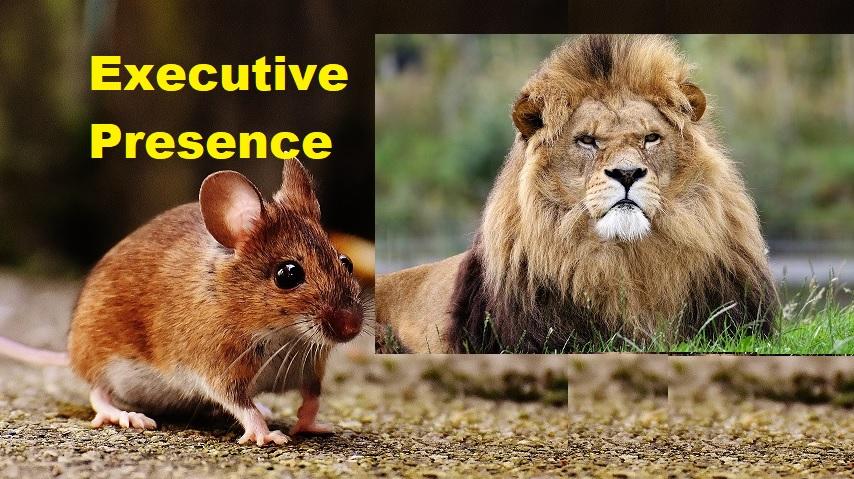
- How you act (gravitas) – Do you show up as a lion or a chipmunk?
- How you speak (communication)- Good listening, concise, to the point delivery, understanding own and other people’s emotions and motivation (Emotional Intelligence).
- How you look (appearance) – Attire, grooming, professional appearance, everything matters.
It might seem overwhelming to improve all these while doing your regular work. But here is the good news. You don’t need to change overnight to improve your Executive Presence. Here are some ideas that worked for my clients and me.
- Some of Pat Kirkland’s techniques are easy to practice in a low-stakes situation to build a habit. Read her blogs here. Also, I discussed some of the meeting/communication techniques in this article, “Having A Hard Time Getting Your Voice Heard In Meetings?“
- When thinking on the feet, one of my clients found that he follows the conversation better and can respond when he is present (not busy typing the notes). These days, he uses a pen and paper to jot down important points. He also came up with the idea of “project managing” his time so that he is intentional about what meetings/topics he would focus on to stay on top of those and feel confident to share his opinions. Here is some more advice.
- One technique that works for me is conciseness in delivering a complex topic. I take a second to gather my thoughts before I speak up. To build the practice, when I read an article, I write a summary of it. Sometimes, I even challenge myself further by posting it on social media. “If you can’t explain it to a six-year-old, you don’t understand it yourself.”- attributed to Einstein,
- Last but not least, I have recently become more aware of my attire and grooming. I didn’t have much awareness in this area during my early career days. I realize I could have used some fashion advice to help improve my executive presence.
Executive presence is a way of being; it is not a “presentation skill.” Pick one thing you want to improve, design practice around it, and do it regularly for a month in everyday situations. You will be surprised by how natural you become!
Relevant read: How to explain anything to anyone: 4 steps to clearer communication and How Fauci exemplifies executive presence,
Learning to Speak Up When You’re from a Culture of Deference